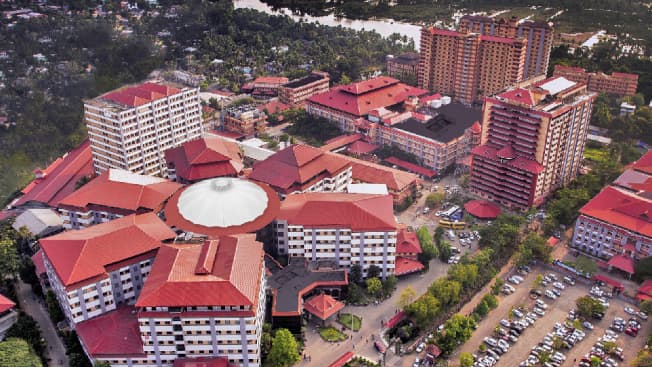
Amrita Hospital has achieved a significant medical milestone by successfully managing a rare and complex pediatric neurological condition, underscoring its expertise in advanced multidisciplinary care involving paediatric neurology, neurosurgery, and long-term intensive pulmonology and rehabilitative care.
The case involved a rare congenital brain disorder affecting one hemisphere of the brain, associated with severe, drug-resistant epilepsy—a condition seen in only a small number of children worldwide. The child hailing from Kolkata had recurrent seizures starting from the first week of life. To complicate things, the child had a severe chronic respiratory infection leading to significant respiratory difficulties . Early onset of seizures, resistance to conventional medical therapy and severe lung infection posed major clinical challenges, necessitating high-risk, early surgical intervention. The baby had to be airlifted to Amrita while mechanically ventilated for further expert care
A multidisciplinary team at Amrita Hospital, including pediatric neurology, neurosurgery and pediatric intensive and pumonology departments , managed the case and decided to proceed with epilepsy surgery to control the seizures. The portion of the malformed brain was disconnected from the rest of the brain through a procedure called hemispherotomy. The young age and associated severe lung I disease made the procedure challenging.. The seizures subsided completely after the procedure. The child had recurrent respiratory infections and needed breathing support through tracheostomy tube ( a tube surgically inserted into the windpipe) and feeding through a gastrostomy tube (a tube surgically inserted into stomach). Ongoing physiotherapy and occupational therapy have contributed to gradual but consistent improvements in motor function, posture, and daily activity. After a long journey of 2.5 years, the anti-seizure medicines were stopped, the tracheostomy and gastrostomy tubes were removed and the family has returned back to Kolkata.
Medical experts note that outcomes of this nature are uncommon in such rare neurological conditions and emphasize the importance of early diagnosis, timely surgical decision-making, and sustained rehabilitation. The case stands as an example of how integrated pediatric multidisciplinary care—combining neurology, neurosurgery, critical care, and pulmonology along with proper rehabilitation—can significantly improve quality of life even in highly complex scenarios.
Doctors at Amrita Hospital highlighted that the successful management of this rare condition has contributed valuable clinical insight and reinforced the hospital’s role as a tertiary referral centre for advanced pediatric neurological care. The clinical care team was led by Dr. Vinayan KP ( Pediatric neurology ) which included , Dr. Ashok Pillai ( Neuro surgery) , Dr. Sajith Kesavan( ICU and pulmonology), Dr. Vyshakh Anand ( Pediatric neurology ) , and Dr. Ravi Sankaran ( Physical medicine and rehabilitation)