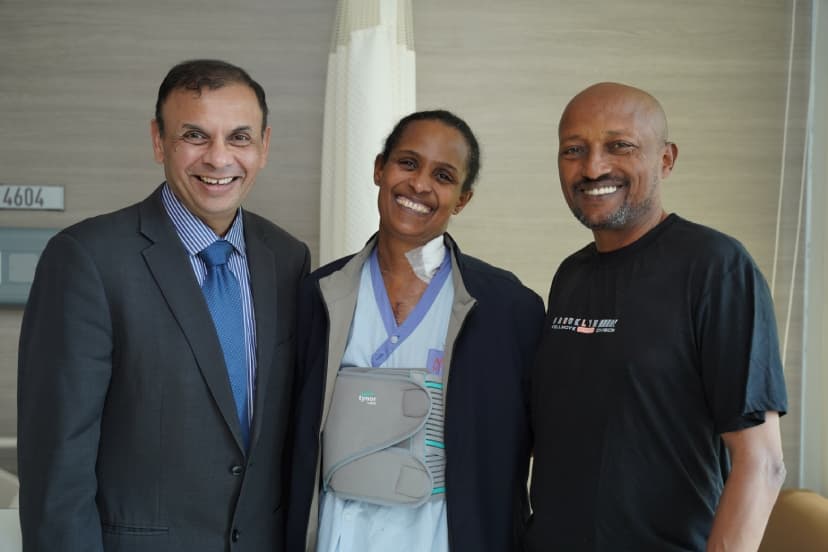
A team of surgeons at Amrita Hospital, Faridabad, successfully completed the highly risky redo Mitral Valve Replacement Surgery on a 44-year-old female patient named Mahlet Tadesse Haile from Ethiopia; she had previously undergone open-heart surgery 18 years ago. This is another step forward in providing comprehensive cardiac care at Amrita Hospital. At the time of her first surgery, Mahlet was a young woman in her mid-twenties with a bioprosthetic mitral valve implanted during her initial open-heart operation.
Throughout her life, Mahlet experienced four full-term pregnancies, which placed great physiological stress on her heart during this time period. As a result of being placed under considerable stress from four pregnancies, Mahlet's tissue valve began to deteriorate eventually and become dysfunctional.
By the end of 2025, Mahlet's mitral valve had to be removed because it had become significantly dysfunctional, resulting in progression of shortness of breath, extreme fatigue, and an inability to complete daily activities as she did before her valve failed. While in Amrita Hospital to assess Mahlet's condition, it was noted that her mitral valve had deteriorated significantly and that she was now suffering from severe pulmonary hypertension, which causes dangerously high levels of blood pressure to build up within the lungs.
An important aspect that contributed to the complexity of this patient’s case was that this patient's heart had been previously operated on (redo cardiac surgery), with the heart now being stuck (adhering) to the sternum (breastbone) because of how the heart was sutured in the first procedure. Due to this condition, there was a significantly increased risk for catastrophic bleeding if the surgeons had to open the patient’s chest and/or if there was bleeding during the procedure. For this reason, the patient’s single functioning kidney presented an additional challenge as careful planning and execution needed to be made at every stage of the surgery and recovery to protect her renal function.
Opening the chest in redo heart surgery, particularly if the heart has an adherence to the sternum, has the potential to be life-threatening. When combined with a single kidney, each step must be performed with precision, remarked Dr. Sameer Bhate, Senior Consultant and Head of the Department of Adult Cardiac Surgery, Amrita Hospital, Faridabad.
He also added that, given the patient’s age, lifestyle, and state of her kidneys, we had a very thorough discussion with the patient and her family on the two options that were available: whether to use a mechanical heart valve or a tissue valve. After much deliberation, we decided to go with a tissue valve to provide the patient with the best possible quality of life.
Despite the very high-risk surgery, it was performed successfully. The patient eventually recovered from her surgery with stable functioning of her kidneys, normalisation of her heart rhythm, and continued progression to her baseline physical strength within a few days of the operation.
Mahlet’s discharge from the hospital was met with an overwhelming sense of gratitude and relief from her family, who had entered India with doubts as to whether or not such an extensive redo surgical procedure was even feasible. They were very pleased to see a considerable improvement in all of Mahlet’s prior symptoms and overall health after the surgery was performed.
Mahlet stated that following the surgery, she felt significant changes in breathlessness and fatigue, symptoms that had progressively gotten worse leading up to surgery, and helped her regain her mobility and independence. Mahlet is now ready to go home to Ethiopia.
This case demonstrates the advanced surgical skill combined with an approach to delivering high-quality and patient-focused care provided by Amrita Hospital, Faridabad, for all patients, including those from India and abroad, when performing complex and high-risk cardiac surgeries.